Updated 5 min read
Where implant charges fall out of the billing workflow
An invoiced implant and a submitted claim sit in different systems on different timelines. Where ASC implant charge capture breaks, and why neither flags it.
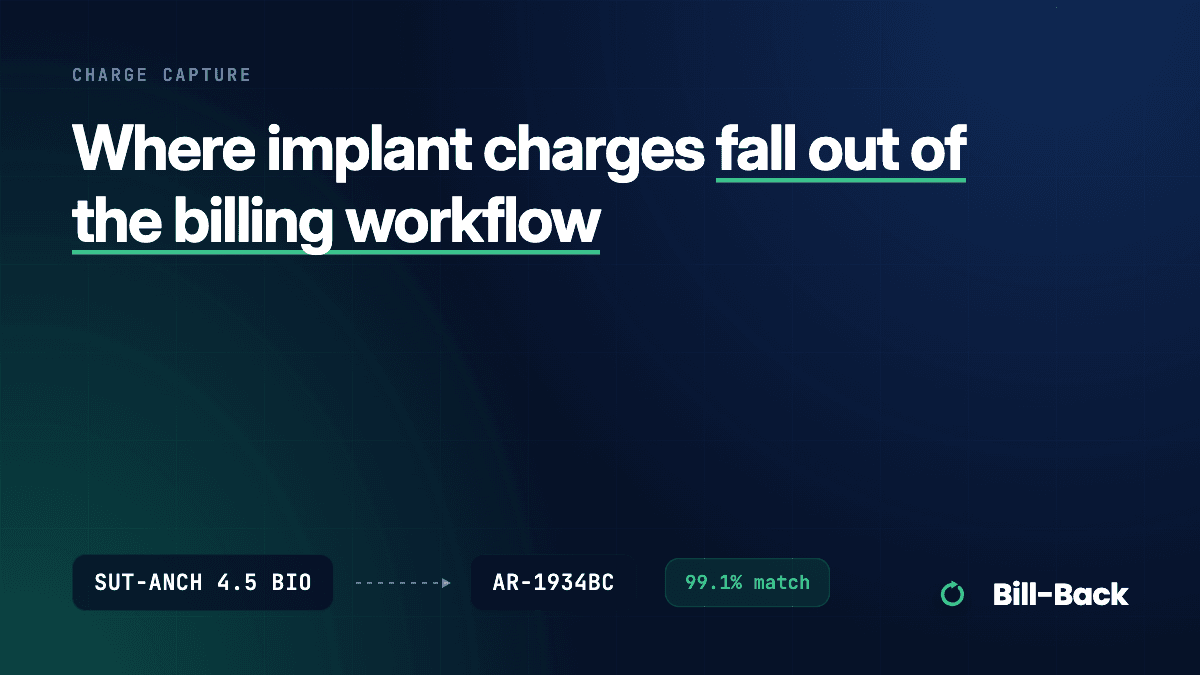
Every ambulatory surgery center tracks the same implant in three systems. The clinical record shows it was used. Accounts payable shows it was bought. Billing shows what was claimed. Each system does its own job, and none of them is built to check the other two.
That is not a failure of attention. It is a question of what each workflow is scoped to answer.
Two records of the same object
When a case runs, the circulating nurse records the implant in the operative note, usually as free text, in whatever shorthand that center uses. SUT-ANCH 4.5 BIO, say.
Weeks later, the vendor invoice arrives. It lists the same physical item under its own catalog number: AR-1934BC.
Two records, one object. They arrive at different times, in different formats, to different teams:
- Materials and AP confirm the implant arrived and approve the invoice for payment. Whether a payer was ever billed for that item is recorded in a different system.
- The billing team or RCM partner codes from the charge sheet and is measured on denial rates and days in AR. The vendor invoice is not an input to that workflow.
Each system does what it was built to do. Creating a charge from the charge sheet is a different act from checking that charge against the vendor's invoice, and neither workflow is built for the second.
The miss is a design limitation
Revenue cycle metrics start counting once a claim exists. Denial rate, days in AR, clean claim rate: every one of them measures how a submitted claim performed.
An implant that was invoiced but never reached a claim produces no denial, no aging, and no exception report. It is not a bad number. It is an absent one.
This is why the gap rarely closes on its own. The tooling that would surface it is watching a population the missed charge was never entered into. A workflow built to resolve claims is not built to catch a claim that was never created.
1–2%
of implant cases, on our conservative working band
The band Bill-Back's own recovery calculator uses. Industry marketing composites commonly cite figures several times higher; we do not rely on those.
At real case volumes that band is not abstract. It resolves to a specific number of implant lines each month that were bought, delivered, documented in the operative note, and paid for by the center, without a corresponding line reaching a payer.
A handful of lines in any single month is easy to wave off. Annualised, the same band is a line item.
- 100 implant cases/mo$18K–$72K
- 150 implant cases/mo$27K–$108K
- 200 implant cases/mo$36K–$144K
Annualised from the same working band: 1–2% of implant cases at $1,500–$3,000 per corrected claim. The solid bar is the low end of each range. This is an estimate for sizing the question, not a projection of money owed: a match is a ceiling until someone confirms the line was never billed.
Those figures are already discounted: they assume a portion of submitted packets are never paid, and they describe recovery before any fee. The point is not the exact number. It is the order of magnitude of a seam that produces no denial and no aging report to flag it.
Reconciling implant invoices against the case log
The reconciliation itself is not a novel idea: specialized ASC billing firms market manual versions of it. What makes it rarely happen is the cost of doing it by hand. For every line on every vendor invoice, someone has to:
- Open the invoice PDF and read the line: catalog number, description, price.
- Find the case it belongs to in the case log.
- Translate the nurse's shorthand in that case's supply note into the catalog number.
- Confirm whether that line was billed.
Then do it again next month, for every invoice that arrived.
Bill-Back takes three documents a center already has:
- The monthly case log export from the PMS (supply notes, CPT, payer, month).
- The vendor invoice PDFs.
- The Paid Claims Report.
The case log carries a billing-status field, but real PMS exports rarely populate it reliably, which is exactly why that status is never trusted on its own. The match runs between what was invoiced and what was documented in the case, priced at the center's contracted rate.
Then there is the step that matters most: a human on the facility's side clears anything already on a claim, and a line cleared that way cannot be turned into a packet. Matched value is a ceiling, not money owed. What survives that pass is what never reached a payer, and each of those becomes a payer-ready Recoup Packet: the corrected claim, the reimbursement basis quoted from the center's own contract, and the matched invoice line as Exhibit A, ready for the center's own biller to submit.
On patient data
Two layers, and the distinction matters.
The file is read in the browser, and only what the audit needs is sent: procedure month, payer, CPT code, procedure description, surgeon name, and supply notes, plus a hashed case reference if one is mapped. The file itself never leaves the browser.
Supply notes are sent as the nurse wrote them, because the device description and catalog number are what the audit matches on. Everything sent is handled under a signed BAA, with encryption in transit and at rest, facility-level isolation, and append-only audit logging.
The short version
Nothing here suggests your billing team is missing something obvious. The invoice and the claim live in different systems, on different timelines, and neither system raises a flag when the two disagree.
The wider set of implant billing questions, from carve-outs to documentation, is in six questions about ASC implant billing. How this gap was first spotted, from outside the industry, is in how Bill-Back came to be.
You can estimate what that seam is worth at your case volume in about thirty seconds, or start a free audit against a month of your own files.
Sources
- “Mastering Proper Implant Charges & ASC Billing Processes”, in2itive Business Solutions. An RCM firm’s guidance, which prescribes matching invoices against the implant log. Vendor-sourced.
- The working band and the recovery figures above come from Bill-Back’s own recovery calculator, and are labelled as ours where they appear.