Updated 7 min read
The Gap Between Two Systems: How Bill-Back Came to Be
By Ben Comstock, Founder
I spent years reconciling accounts in finance. Then I found the same gap between two systems costing ASCs their implant revenue, so I’m building Bill-Back to close it.
A few months ago, a close friend introduced me to the world of ambulatory surgery centers. I didn’t know much about ASCs at the time. I knew even less about implant billing. But I knew reconciliation problems from my previous work in finance while working for a multinational HR Tech company in Granada, Spain.
Every month, the same fight: payables didn’t match what we expected on the receivable side. Not because anyone was doing anything wrong, but because two teams were each doing their own job correctly, and the systems they worked in weren’t built to cross-check each other. Operations sold our consultants to our clients. Our clients paid us for our consultants’ time. My job was to sit in that space between and find the mismatch before it became a real problem.
When I started researching how ASCs get paid for the implants they use in surgery, I recognized the shape of it immediately. Same problem. Different industry. And once I started digging, I realized this isn’t a rare edge case. It’s structural, and it’s costing surgery centers real money every month.
This isn’t a failure of attention. It’s a design limitation.
Here’s how it plays out inside a surgery center.
A nurse notes an implant in the clinical record during a case. Materials and AP confirm the vendor invoice arrived and pay it. Billing codes the case from the charge sheet and submits the claim. Three systems, three separate confirmations: the clinical record shows the implant was used, accounts payable shows the invoice is correct, billing shows the claim went out. Each one does its job, and none of them is built to check the other two.
That’s the gap, and it’s structural. The materials system and the billing system aren’t built to check, case by case, whether the vendor invoice and the claim agree. Doing it by hand would be extremely time consuming.
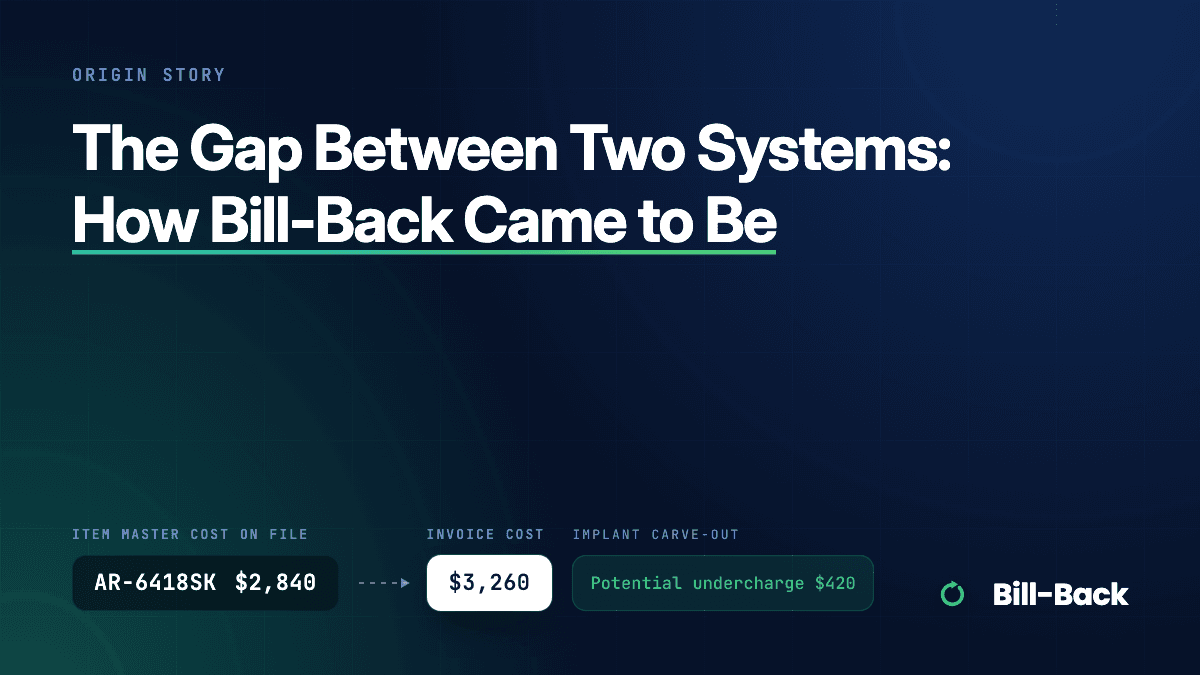
It gets worse once you look at where the price actually comes from. Most practice management systems auto-populate the charge from the center’s own Item Master, not from the vendor’s actual invoice. So even a center charting and billing in a single unified system (SIS, HST, etc.) is pricing implants off an internal number that may not reflect what the vendor billed. The nurse’s supply note says one thing. The vendor invoice, which arrives weeks later under its own catalog number, says another. Unless a person sits down and manually compares the two, line by line, neither system is built to surface the mismatch. The implant either goes unbilled entirely, or gets coded as bundled with the procedure when it should have been billed separately, or is reimbursed at an outdated rate, amongst other reasons.
Multiply that across every implant case, every month, and the size of this problem becomes apparent.
What this actually costs ASCs
The industry doesn’t talk about this loudly, because it doesn’t look like a crisis. It looks like a rounding error, repeated indefinitely. But the numbers tell a different story.
Becker’s ASC Review has reported that the combined effect of missed charges, uncontested underpayments, and AR delays quietly erodes ASC margins.
5–15%
of margin per case, eroded by missed charges, uncontested underpayments and AR delays
Becker’s ASC Review, April 28 2026, reporting operator estimates. Trade press rather than an independent study.
Other billing analysts in the space have looked at unbilled or underbilled implant charges alone at a busy multi-OR center, and landed in this range depending on case volume and procedure mix.
$180,000–$650,000
a year in unbilled or underbilled implant charges at a busy multi-OR center
Medical Billers and Coders, July 19 2026, rounded from a stated $648,000 high end. A billing services vendor’s own industry analysis, not an independent study.
Numbers like these vary by source and should be read as industry estimates rather than a fixed rule, but they all point the same direction: implant charge capture is one of the largest and most persistent leaks in ASC revenue cycles, and it’s largely invisible until someone goes looking for it.
- 100 implant cases/mo$18K–$72K
- 150 implant cases/mo$27K–$108K
- 200 implant cases/mo$36K–$144K
Annualised from the same working band: 1–2% of implant cases at $1,500–$3,000 per corrected claim. The solid bar is the low end of each range. This is an estimate for sizing the question, not a projection of money owed: a match is a ceiling until someone confirms the line was never billed.
It’s invisible because of how ASC billing teams are measured. Billing is judged on how fast claims move and how clean they are, not on whether every purchased implant made it onto a claim in the first place. An RCM partner is judged on denial rates and days in AR, both of which only start counting once a claim exists. An implant that was invoiced by the vendor but never made it onto a claim at all doesn’t show up in either metric. It’s not a denial. It’s not aging AR. It’s just gone, quietly, before it ever entered the system that would have caught it.
That’s what makes this different from most billing problems people already have tools for. Denial management software watches claims after they’re submitted. Charge capture audits typically work off the center’s own Item Master, the same internal list that caused the mismatch in the first place. A typical ASC’s workflow isn’t built to compare the vendor’s actual invoice, the ground truth of what was purchased, against what got billed to the payer.
When not being so close to the problem helps.
I want to be clear. I didn’t spot this because I understand ASC operations better than the people running them. I don’t. Not even close! Administrators, directors, and billers who work in this industry every day understand the operational reality far better than I ever will.
What I brought wasn’t healthcare expertise. It was a specific instinct, built over years of reconciliation work: distrust of any process where two records are supposed to match but nothing in it is built to check that they do. In global finance, we called that an open item. You don’t assume it nets out on its own. You go find it, prove where the money actually went, and close it.
ASCs have exactly this kind of open item, sitting between materials, AP, and billing. It just hasn’t been named that way, because the systems each function works in were built for that function’s own job, not for reconciling invoices against claims. It’s an artifact of how the workflow evolved, three functions each doing their part correctly, in systems that aren’t built to cross-check each other line by line.
What Bill-Back actually does about it
Bill-Back reads three documents an ASC already has: the monthly case log export from the practice management system, the vendor invoices such as Stryker and Arthrex, and the Paid Claims Report.
It matches the nurse’s supply note from every case against the actual implant on the vendor’s invoice, and prices it at the center’s contracted rate rather than the internal Item Master.
Anything already billed gets cleared with one tap. Anything that never made it onto a claim, or was billed as bundled when it shouldn’t have been, becomes a payer-ready Recoup Packet: the corrected claim, the reimbursement basis quoted from the center’s own contract, and the matched invoice line as Exhibit A, ready for the center’s existing biller or RCM partner to submit.
That last part matters. Bill-Back isn’t trying to replace a center’s billing team or RCM company. Those teams are doing their job well within the boundaries of what they’re measured on. Bill-Back works the seam those metrics don’t cover, and hands back something the existing team can act on immediately.
Every match carries a confidence score, and anything below 98% goes to a human review queue rather than getting auto-approved on a guess. Files are read in the browser, and only what the audit needs is sent: procedure month, payer, CPT code, procedure description, surgeon name, and supply notes, plus a hashed case reference if one is mapped. Everything sent is handled under a signed BAA.
And because this is recovered revenue an ASC already earned, not new revenue extracted from somewhere else, the audit is free, with no cost unless it recovers something. Bill-Back is paid a flat contingency fee on recoveries only after the payer’s payment is confirmed. If the audit finds nothing, the center owes nothing. If the payer never pays, the ASC owes nothing.
Where this goes from here
I’m early in this ASC world, and I’d rather say that plainly than dress it up. What I have is a problem I’m confident is real, seen clearly enough from the outside to build a tool for it, and validated by industry leaders who work inside ASCs every day.
If you run billing, materials, or operations at an ASC and any part of this sounds familiar, I’d genuinely like to hear how it shows up at your center. Pull your last 10 implant invoices and compare them against what you actually billed. If they match, that’s good to know. If they don’t, you’ve just found where some of your margin has been going.
That gap, between systems that each do their job but aren’t built to check each other, is what Bill-Back exists to close.
You can size it at your own case volume in about thirty seconds, or start a free audit against a month of your own files.

Ben Comstock
Founder
Sources
- “The financial mistakes crushing ASC profits”, Becker’s ASC Review, April 28 2026.
- “Is Your ASC Billing Partner Helping Your Surgery Center Grow?”, Medical Billers and Coders, July 19 2026. A billing services vendor’s industry analysis.