8 min read
How ASCs are reimbursed, and where implants fit
Medicare pays an ASC per procedure, on rates tied to hospital outpatient payment. Commercial payers pay by contract. How each works, and where implants fit.
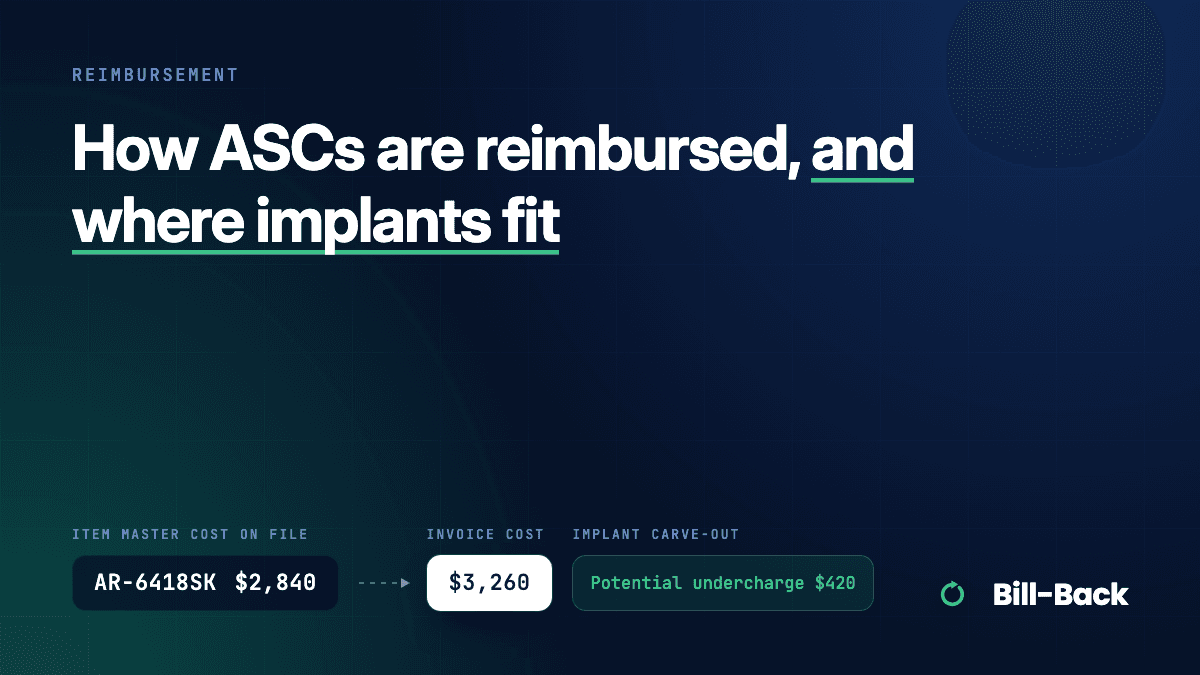
An ASC is paid a facility rate for each surgical procedure. Medicare sets that rate for about 4,300 covered procedures under its ASC payment system, built from hospital outpatient weights and adjusted for local wages. Commercial payers pay what their contract says, often a percentage of the Medicare rate or a grouper rate. Implants follow rules of their own.
The rest of this blog is about one line on the claim, the implant, and six questions about ASC implant billing is where that starts. This post starts a step earlier, with the facility claim the implant sits on. It is read from MedPAC’s October 2026 summary of the ASC payment system, Chapter 14 of the Medicare Claims Processing Manual, one commercial payer’s published grouper policy, a 2026 health policy review, and the Texas workers’ compensation fee guideline.
What is ASC billing?
ASC billing is how an ambulatory surgery center gets paid for the facility side of an outpatient surgery: the operating room, nursing, recovery care, drugs and supplies. The surgeon and the anesthesia provider bill separately for their professional services. Medicare takes the facility claim in its professional claim format, the 837P or Form CMS-1500. Commercial payers each name their own.
MedPAC draws the same line. Medicare pays for the facility services under the ASC payment system and for the related physician services, the surgery and the anesthesia, under the physician fee schedule.
Two things follow for the facility. First, Medicare pays it only for procedures on a list. Chapter 14 says Medicare makes facility payments to ASCs “only for the specific ASC covered surgical procedures on the ASC list of covered surgical procedures,” plus separate payment for certain ancillary services furnished integral to one of them. MedPAC describes the list as procedures that do not pose a significant safety risk in an ASC and do not need an overnight stay, updated every year.
Second, the claim form is not settled once per facility. Chapter 14’s claim instructions are headed “ASC Procedures for Completing the ASC X12 837 Professional Claim Format or the Form CMS-1500,” while several commercial payers write their ASC implant policies around the UB-04. That split is covered in which claim form a commercial payer wants.
How are ASCs reimbursed?
Per procedure, at a rate someone else sets. For Medicare that rate is public and recalculated every year. For a commercial payer it sits in a contract that is not public. A workers’ comp claim is paid from a state fee schedule. In each case the implant may be inside the procedure rate or paid on a line of its own.
| Payer | What sets the rate | Implants | Where the rate is written |
|---|---|---|---|
| Medicare | The ASC payment system: a relative weight per procedure, times an ASC conversion factor, half of it adjusted for local wages | Packaged into the procedure payment, except pass-through devices | CMS’s annual payment rule and quarterly rate files, which are public |
| Commercial payers | The contract: commonly a percentage of the Medicare ASC rate, or a grouper rate | Whatever the contract says, from no separate payment to a carve-out | The payer contract, which is not public |
| Workers’ comp, Texas as the example | The state fee guideline: 235% of the Medicare ASC rate for a procedure that is not device-intensive | Paid separately at cost plus an add-on when the facility requests it, with the procedure then paid at 153% | 28 Tex. Admin. Code section 134.402 |
Read down the second column and one rate keeps appearing. The Medicare ASC rate sets prices well beyond Medicare. A commercial contract benchmarked to it moves when it moves, and the Texas workers’ comp guideline is written as a multiple of it. That is why the Medicare system is worth understanding even at a center whose implant money comes from commercial payers.
What payment system does Medicare use for ASCs?
Medicare pays ASCs under the ASC payment system, revised in 2008 and tied mostly to the hospital outpatient prospective payment system (OPPS). Each covered procedure sits in a payment group with a relative weight. CMS multiplies that weight by an ASC conversion factor, adjusts the labor half of the rate for local wages, and updates both every year.
MedPAC, the commission that advises Congress on Medicare payment, sets out the parts in its October 2026 summary.
- The unit of payment is the procedure. Each of the approximately 4,300 procedures approved for payment in an ASC is classified into an ambulatory payment classification (APC) group “on the basis of clinical and cost similarity.” There are several hundred APCs, and all services within one have the same payment rate. The ASC system largely uses the same APCs as the OPPS.
- Relative weights come from the hospital side. For most procedures they are based on the OPPS relative weights. CMS then scales every ASC weight by one factor so that new weights do not change total ASC spending. In 2026 that factor was 0.872, which put ASC weights 12.8% below the OPPS weights.
- The conversion factor is lower than the hospital one. It turns a weight into dollars.
- Half the rate is adjusted for local wages. The labor-related half of the conversion factor is adjusted by the hospital wage index, on the basis of Government Accountability Office research concluding that labor is 50% of ASC costs.
- Both parts are updated every year. Since 2019, CMS has updated the conversion factor by the hospital market basket, minus a productivity adjustment. ASCs that do not report a set of quality measures take a 2% reduction.
$56.32
ASC conversion factor for 2026, which MedPAC puts at 61% of the hospital outpatient conversion factor
MedPAC, Ambulatory Surgical Center Payment System, Payment Basics, revised October 2026, with policies current as of September 30, 2026. ASCs that do not submit quality data face a 2% reduction.
Chapter 14 adds how the rate becomes a payment. In general, Medicare pays the ASC 80% of the lesser of the actual charge or the ASC payment rate, and the patient pays 20% of the same lesser amount; screening colonoscopies are among the exceptions. MedPAC puts the Part B deductible at $283 in 2026. The comparison with the charge is made line by line, which is why Chapter 14 tells ASCs to fold the charges for packaged items into the procedure line rather than listing them separately.
When more than one procedure is done in the same session, Chapter 14 section 40.5 has the contractor pay 100% of the highest paying procedure and 50% of the rate for the others that are subject to the multiple procedure discount. Which procedures are subject to it is set in each year’s final rule.
Some services are paid by a different method. MedPAC lists four: new office-based procedures and separately payable radiology, paid at the lower of the ASC rate and the practice expense part of the physician fee schedule rate in an office; separately payable drugs, paid what the OPPS pays; and device-intensive procedures, which matter for implants and are covered in the implant section below.
How do commercial payers reimburse ASCs?
By contract, and the contracts are not public. Two methods appear in published sources: a percentage of the Medicare ASC rate, and a grouper, which sorts procedures into payment groups with one rate per group. High-cost implants can be carved out of either and paid on their own terms.
A percentage of Medicare. A 2026 health policy review in Pain Physician, on the Medicare ASC rules proposed for 2027, puts it this way: “ASC facility-fee schedules in commercial contracts are commonly benchmarked to a percentage of the current Medicare ASC rate.” The consequence it draws is the one to plan around. Under that kind of benchmark, a Medicare cut “may automatically flow into commercial reimbursement unless the contract language specifies otherwise.” The authors suggest fixed-year Medicare references instead of floating ones, and “separate case-rate or carve-out provisions for high-cost implantable devices.”
A grouper. EmblemHealth publishes an ASC grouper reimbursement policy, written “for EmblemHealth contracts that follow grouper payment methodology.” It assigns each CPT or HCPCS code to a group. In the 2026 version, CPT 29888 (ACL reconstruction) and 29827 (rotator cuff repair) are both in group 6, and 27447 (total knee replacement) is in group 7. The policy does not print a dollar amount per group, which we read as the rate being set in each contract. Read that way, two procedures in the same group are paid the same whatever implant each one used, unless the contract carves the implant out.
Implants. How a commercial contract pays for the implant itself varies as much as the procedure rate does. Six questions about ASC implant billing describes four models in use, from no separate payment to a negotiated carve-out, and what an ASC implant carve-out has to define covers what the carve-out language has to settle.
Workers’ comp sits between the two worlds. The fee schedule is public, like Medicare’s, but it can pay for the implant separately, like a contract. Texas pays a procedure that is not device-intensive at 235% of the Medicare ASC rate when the implant stays inside the procedure payment, and at 153% plus the implant’s cost and an add-on when the facility asks for separate implant payment.
Where do implants fit?
It depends on the payer. Medicare packages most implants into the procedure payment and pays separately only for pass-through devices, and for a device-intensive procedure it prices the device portion at the hospital outpatient amount. A commercial or workers’ comp payer may pay the implant on its own line, at cost or cost plus a markup, if the contract or fee schedule says so.
The Medicare side has three parts.
- Packaged. MedPAC’s summary says CMS packages most ancillary items and services with the procedure, and what the CMS manual actually says about ASC implant billing traces the rule for implants: an implant without pass-through status is part of the procedure payment and is denied if billed on its own line.
- Pass-through. ASCs can be paid separately for implantable devices eligible for OPPS pass-through payment, which MedPAC describes as specific new-technology items too new to be well represented in CMS’s rate data. Chapter 14 has them contractor-priced on acquisition cost or invoice.
- Device-intensive. Where the device is more than 30% of the procedure’s total payment, CMS splits the payment in two. The ASC gets what the OPPS would pay for the device portion and the standard ASC rate for the rest.
On the commercial side, the rule is whatever the contract says, and the contract may say the opposite of Medicare. So the same implant can be inside the procedure rate on one claim and a separately paid line on the next. Whether an implant needs its own line is decided by the payer, not by the implant. In our view, that is one way an implant line goes missing: a billing habit that is right for Medicare, no implant line, is wrong on a commercial claim whose contract carves the implant out. Which code goes on an ASC implant line covers the line itself, and what an implant claim needs behind it the documents a payer can ask for.
Where Bill-Back fits
This blog belongs to a company that sells a fix for one part of the above, so read this section as the pitch it is.
Bill-Back works the commercial side of that split: implants a contract pays for on their own line. It reads three documents a center already has: the monthly case log export from the PMS, the vendor invoice PDFs, and the Paid Claims Report, which shows which implant lines were already billed. Your file is read in your browser, and only what the audit needs is sent: procedure month, payer, CPT code, procedure description, surgeon name, and supply notes, plus a hashed case reference if you map one. Everything sent is handled under a signed BAA.
Each supply note is matched to a vendor catalog number, and anything already on a claim is cleared, from the Paid Claims Report or by someone on your side. What survives becomes a payer-ready Recoup Packet: the corrected claim, the reimbursement basis quoted from your own contract, and the matched invoice line as Exhibit A, for your own biller to submit. A corrected claim inside the filing window, not an appeal.
Commercial payers, plus workers’ comp through manual review. Not Medicare, because the implant is packaged into the procedure payment there. Free to audit. You only pay when the payer pays.
You can estimate what that seam is worth at your case volume in about thirty seconds, or start a free audit against a month of your own files.
Sources
Government and regulatory
- Ambulatory Surgical Center Payment System, Payment Basics, Medicare Payment Advisory Commission (revised October 2026; policies current as of September 30, 2026).
- Medicare Claims Processing Manual, Chapter 14: Ambulatory Surgical Centers, CMS (Rev. 13836, issued June 24, 2026). Sections 10.2, 30, 40, 40.5 and the section 50 heading.
- Ambulatory Surgical Center (ASC) Payment, CMS. The covered procedures, payment indicators and quarterly rate files.
- 28 Tex. Admin. Code section 134.402, Ambulatory Surgical Center Fee Guideline, via Cornell LII.
- Ambulatory surgical center fee guideline FAQ, Texas Department of Insurance, Division of Workers’ Compensation.
Payer policy
- Reimbursement Policy: ASC Grouper 2026, EmblemHealth, policy RPC20230048 (review date October 15, 2026).
Journal
- Manchikanti L, Sanapati MR, Pampati V, et al. Ambulatory Surgery Centers and Medicare Payment Policy for Calendar Year 2027: Impact on Interventional Pain Management. Pain Physician 2026; 29:E469–E480. A health policy review; its statement about commercial contracts is the authors’ observation, not a survey.